UK Horse Racing Betting Guide
Best Bet in Horse Racing: A Data-Driven UK Punter’s Playbook
 Available in US
Table of Contents
- Two Words, Two Meanings — and a Market That Punishes Confusion
- The Punter’s Playbook in 90 Seconds
- What “Best Bet” Actually Means in UK Racing
- The UK Racing Betting Landscape Right Now
- Favourite Win Rates: What the Data Actually Shows
- Types of Bets and When Each One Is Your Best Option
- Form Reading: The Five Things That Actually Matter
- Value Betting: Why the Price Matters More Than the Horse
- Choosing and Using UK Bookmakers for Racing
- Bankroll and Staking: The Maths of Staying in the Game
- The Four-Filter Decision Framework
- Flat vs National Hunt: Two Sports, Two Betting Mindsets
- Five Mistakes That Drain Your Racing Bankroll
- The 2026 Regulatory Landscape and What It Means for Your Betting
- Frequently Asked Questions About Best Bets in Horse Racing
- Where Value, Form and Discipline Meet
Two Words, Two Meanings — and a Market That Punishes Confusion
Type “best bet in horse racing” into any search bar and you will get two completely different answers depending on who is writing. One crowd means the single sharpest selection of the day — the nap, the banker, the one the tipster would mortgage the house on. The other crowd means the smartest type of wager you can place given the race conditions, the field size and your own bankroll. I have spent nine years working across UK Flat and National Hunt racing, and I can tell you that mixing up these two definitions is the fastest way to bleed money. This playbook treats both: how to identify the strongest individual pick and how to structure that pick into a bet that actually makes mathematical sense.
The timing matters too. British racing is in a strange spot right now. The Horserace Betting Levy Board collected a record £108.9 million from bookmakers in 2024-25 — the highest figure since 2017 — yet total betting turnover fell 9% in the first quarter of 2025 compared with the same stretch in 2024. BHA Director of Racing Richard Wayman put it plainly: total betting turnover has fallen, and whilst there is work to be done on the racing product, a much wider range of factors is contributing to that concerning decline. Affordability checks, tighter regulation and a shifting tax landscape mean the environment you are punting in today looks nothing like it did even two years ago.
What follows is the framework I use every morning when I sit down with a racecard. It is built on Gambling Commission data, BHA reporting, and a decade’s worth of bets that taught me what the numbers alone cannot. Whether you are placing your first each-way or looking for a sharper edge, every section earns its place by answering one question: does this make my next bet better?
Before we get into the detail, here is the whole playbook compressed into a few bullet points — the numbers and habits that separate consistent punters from everyone else.
The Punter’s Playbook in 90 Seconds
- Favourites win roughly 30-35% of UK races overall, dropping to 26-27% in handicaps and rising to 39% in non-handicap events — blindly backing the market leader returns about 93p for every pound staked over time.
- Best Odds Guaranteed adds an estimated 5-10% to annual returns at zero extra risk — yet many punters still bet with a single bookmaker and miss it.
- The 1-2% staking rule — risking no more than two per cent of your bankroll per race — is the simplest habit that keeps you solvent through losing runs.
- Using two or three bookmaker accounts to compare prices delivers 2-5% better long-term returns versus sticking to one operator.
- Finding value matters more than finding winners: a punter who backs fewer horses at prices above their true probability will outperform one who backs every favourite on the card.
Your best bet is never just a horse — it is a horse at the right price, in the right race type, with the right stake. Everything below is built around that principle.
What “Best Bet” Actually Means in UK Racing
A friend of mine — decent judge of a horse, terrible judge of his own vocabulary — once told me he had “found the best bet at Newbury” and then placed a 50p Lucky 15 on four outsiders. His idea of “best bet” was his personal pick. Mine was the bet structure. We were speaking the same two words in entirely different languages, and we both lost money that afternoon for entirely different reasons.
In the UK racing world, “best bet” carries at least three distinct meanings, and the overlap is where most confusion lives.
Meaning 1: A tipster’s nap. The single strongest selection of the day, the one a professional tipster or analyst stakes their reputation on. Racing Post’s nap table, Sporting Life’s best bets column, OLBG’s community picks — all use the phrase this way. It is a selection, not a strategy.
Meaning 2: Your own card analysis pick. You sit down with the racecard, study form, going, draw bias, trainer patterns, and arrive at a horse you rate above the market price. This is your best bet — personal, contextual, and only as good as your reading of the race.
Meaning 3: The optimal bet type for a given situation. Win-only in a small field, each-way in a competitive handicap, a forecast when you fancy two from the same yard — here “best bet” means structural choice, not individual selection.
British horseracing is deeply interlinked with the gambling sector as one of the most popular products on which people bet, as the DCMS Select Committee once noted. That link means every media outlet, bookmaker, and forum has its own spin on “best bet”, and they are rarely talking about the same thing.
| Tipster’s Best Bet | Your Best Bet |
|---|---|
| One selection staked daily, reputation-driven | Only acted on when value and form align |
| Publicly shared, widely followed — market impact | Private, no market pressure on price |
| Judged on strike rate and profit to advised prices | Judged on long-term ROI against your own prices |
| Fixed stake model (1pt per nap) | Flexible stake based on edge size and bankroll |
This article treats all three meanings. Sections on form reading and value help you sharpen meaning two. Sections on bet types and staking cover meaning three. And the decision framework later on ties them together so that every bet you place qualifies as your “best bet” in every sense.
The UK Racing Betting Landscape Right Now
I pulled up the Gambling Commission’s latest industry statistics the other morning and nearly spat out my coffee. The numbers tell a story of an industry simultaneously collecting record levies and watching its customer base shrink — and if you are betting on horses in Britain in 2026, you need to understand that contradiction because it affects the odds you are offered, the promotions you can access, and the limits you will hit.
£766.7m
Gross gambling yield from remote horse racing bets, April 2024 to March 2025
2nd
Racing’s position behind football (£1.3bn) in UK betting GGY
85,000
Jobs supported by the racing industry, 20,000+ directly at 59 licensed racecourses
£4.1bn
Total annual economic contribution of British racing, including induced effects
Racing generates direct revenues exceeding £1.47 billion and makes a total annual contribution to the UK economy of £4.1 billion according to the British Horseracing Authority’s own study. Those are not small figures, and they explain why the Treasury pays attention to every percentage point it taxes this sector. The industry supports around 85,000 jobs, with more than 20,000 people employed directly at licensed racecourses.
Yet behind the headline figures sits a market under genuine pressure. Betting turnover on racing fell 9% in the first quarter of 2025, and the nine-month picture was worse: a 4.2% decline year on year, and a 12.8% drop compared with the same period in 2023. Average turnover per race slid 5.8% year on year. The online racing handle has fallen by £1.6 billion since 2022 — factoring in inflation, that translates to a real-terms contraction of roughly £3 billion. Lord Charles Allen, Chairman of the BHA, framed the stakes bluntly: racing is Britain’s second-largest spectator sport, supporting 85,000 jobs and delivering over £4 billion of economic value every year, yet all of that is now being put at risk.
The tax picture adds another layer. From April 2026, Remote Gaming Duty rises from 21% to 40% — though racing retains a lower combined effective rate of around 25% (15% General Betting Duty plus the 10% Horserace Betting Levy). From April 2027, General Betting Duty for remote bets is set to increase to 25%. Independent modelling found that even a harmonised rate of 21% would have cost the racing industry about £66 million a year and potentially threatened 2,752 jobs.
The Horserace Betting Levy Board collected a record £108.9 million in 2024-25 — the highest since 2017 — even as betting turnover per race fell 8% year on year and 19% compared with 2021-22. A rising levy on a shrinking pie.
For you as a punter, these pressures translate into tighter odds margins, fewer and less generous promotions, and stricter account management. Understanding the landscape is not academic — it shapes the environment in which every bet you place lives or dies.

Favourite Win Rates: What the Data Actually Shows
Every Saturday afternoon at the pub someone announces, with absolute conviction, that “the favourite always wins.” I used to argue back. Now I just show them the numbers, because the numbers are more interesting than the argument.
Across all UK races, the market favourite wins roughly 30-35% of the time. That is the headline, and it is the figure that most people stop at. But the useful detail lives in the breakdown. In non-handicap races — maidens, novice events, conditions stakes — the favourite’s strike rate climbs to about 39%. In handicaps, where the weights are designed to level the field, it drops to 26-27%. The second favourite wins 18-21% of the time, and the third favourite manages 12-15%. Add those up and the top three in the market account for 65-70% of all winners — which tells you that the market as a whole is reasonably efficient even if the individual leader is not.
| Category | Favourite Win Rate | Approx. Level-Stake ROI |
|---|---|---|
| All UK races | 30-35% | ~93% (loss of ~7%) |
| Non-handicap | ~39% | ~95% |
| Handicap | 26-27% | ~89% |
| Second favourite (all) | 18-21% | ~88% |
| Third favourite (all) | 12-15% | ~85% |
That ROI column is the one that matters most. Backing every favourite at level stakes returns about 93p for every pound wagered. You win often enough to feel like you have a system, but over hundreds of bets you are grinding away your bankroll at roughly 7% per cycle. For second favourites the drain is steeper at around 88p return per pound, and third favourites bring back about 85p. Frequency of winners is not the same thing as profitability, and that distinction is the single most important idea in this entire article.
Course-level data throws up some extreme outliers. Lingfield recorded a 50% favourite win rate over one recent sample of 44 races — 22 winners from 22 market leaders. At the Cheltenham Festival 2024, favourites won 33% of races. These snapshots are interesting but dangerous to build a strategy around: small sample sizes produce wild variance, and what happened at one track over one period rarely predicts what will happen next.
So should the favourite always be your best bet? No. The favourite is the market’s best guess, and the market is right about a third of the time. Your job is not to follow that guess blindly but to identify when the market has it wrong — and that is where form reading and value assessment come in. For a full breakdown of favourite statistics by race type, course and field size, I go into much more detail in the favourite horse racing betting statistics analysis.
Types of Bets and When Each One Is Your Best Option
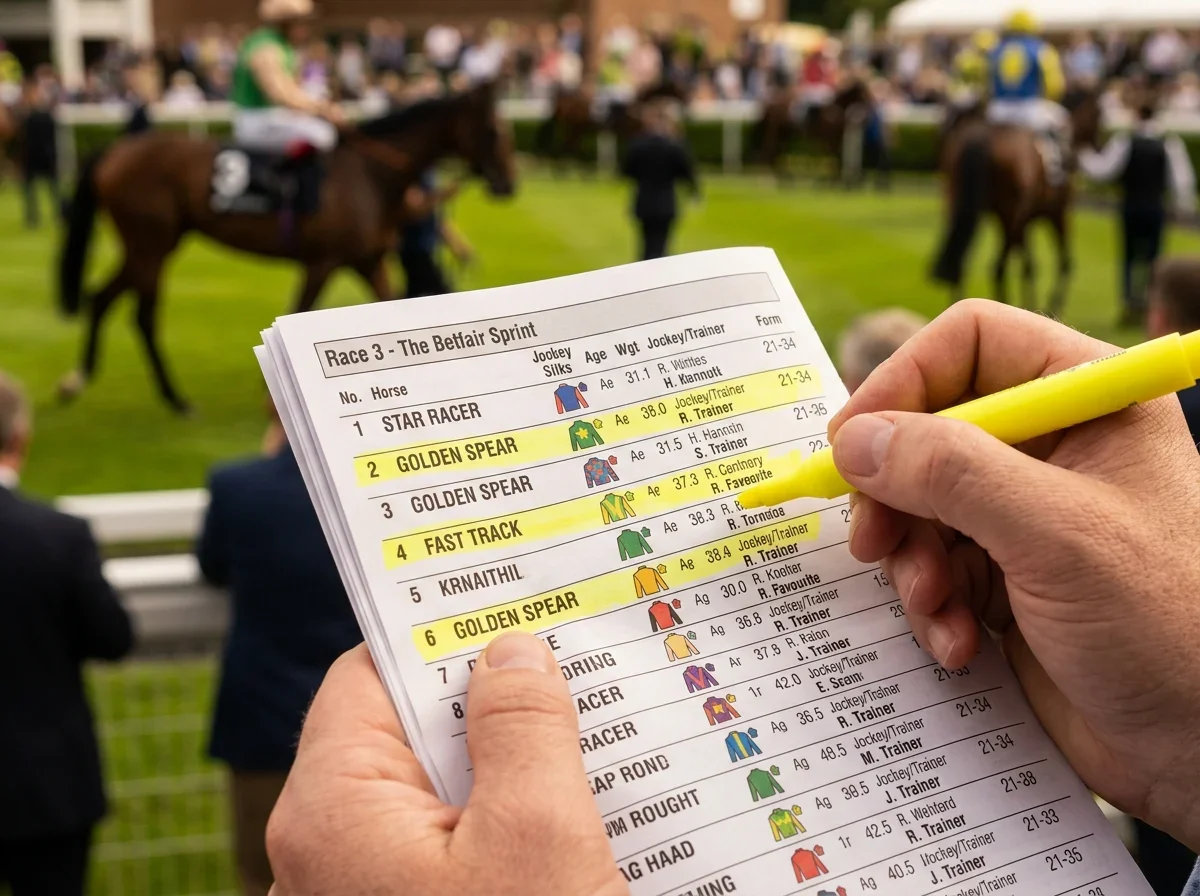
I once watched a punter at Cheltenham place a five-horse accumulator at combined odds of roughly 800/1. He had done his form homework — genuinely sharp selections, every one of them. Four of the five won. He collected nothing. A single win bet on any of those four would have turned a profit. The structure of the bet was wrong for the situation, and all the form reading in the world could not fix that.
Choosing the right bet type is not glamorous, but it is the foundation that everything else sits on. Here is how each one fits into the “best bet” equation.
Win Betting
A win bet is the purest racing wager: back a horse, it needs to finish first. It fits best in small fields (six runners or fewer) and non-handicap events where the favourite’s 39% strike rate gives you a meaningful baseline. If you have identified genuine value at the price, a win bet captures the full edge without dilution.
Each-Way Betting
Each-way splits your stake into two equal parts: one on the win, one on the place. Place terms vary by field size — typically 1/4 odds for four places in handicaps of 16+ runners, or 1/5 odds for two or three places in smaller fields. The each-way bet is strongest in competitive handicaps with eight or more runners.
Each-way calculation example
Suppose you back a horse at 10/1 each-way, £5 total stake (£2.50 win, £2.50 place), with 1/5 odds for three places.
If the horse wins: Win part returns £2.50 x 10/1 = £25 + £2.50 stake = £27.50. Place part returns £2.50 x 2/1 = £5 + £2.50 stake = £7.50. Total return: £35. Profit: £30.
If the horse places (2nd or 3rd): Win part loses £2.50. Place part returns £7.50. Total return: £7.50. Profit: £2.50.
If the horse finishes 4th or worse: Both parts lose. Total loss: £5.
That safety net on a placed finish is where each-way betting earns its reputation — but it only works when the odds and place terms justify splitting the stake. At short prices (under 4/1), the place return barely covers the dead-money on the win portion. For a thorough breakdown of when the maths favours each-way over win-only, I cover the mechanics in the each-way betting horse racing guide.
Forecast, Tricast, Accumulators and Lucky 15s
Forecasts (predicting the first two) and tricasts (the first three) suit races where you have a strong view on multiple runners, but both are high-variance bets that should occupy a tiny fraction of your activity. Accumulators compound the bookmaker’s margin with every leg — the headline odds look enormous, the probability of landing them is minuscule. A Lucky 15 (four selections, 15 bets) cushions the all-or-nothing problem but costs fifteen times your unit stake. Entertaining formats, not long-term strategies.
SP (Starting Price) — the official odds at the moment the race begins, determined by on-course bookmakers. Used as the settlement price when no fixed odds have been taken.
BOG (Best Odds Guaranteed) — a bookmaker promise that if the SP is higher than the price you took, you are paid at the SP instead. Effectively free upside on early prices.
NAP — a tipster’s strongest selection of the day. From “Napoleon” (the card game), meaning the highest bid.
The right bet type depends on the race, not your mood. A six-runner novice hurdle calls for a win bet. A 20-runner heritage handicap screams each-way. Match the structure to the situation and you have already taken a step most recreational punters skip.
Form Reading: The Five Things That Actually Matter
Here is a confession that will not surprise anyone who has stood in front of a racecard for ten minutes feeling overwhelmed: most form data is noise. When I started out I tried to weigh every column, every footnote, every speed figure. I ended up with analysis paralysis and a shrinking bankroll. Nine years later, I have whittled the essential inputs down to five. Everything else is either already priced in or too unreliable to act on.
Recent Results and the Form String
The form string — that row of numbers and letters next to a horse’s name — is shorthand for finishing positions in recent runs. A horse showing 1-2-1 has been running consistently near the front. One showing 0-P-7 has been struggling. But raw positions only tell part of the story. A horse beaten half a length into second in a Group 1 is running far better than one winning a weak seller by six lengths. Context matters more than digits.
Going Preferences
The going — the condition of the ground — is the single most underrated factor in UK racing. Some horses are transformed on soft ground and cannot act on fast. A horse’s going record is in its form comments, and ignoring it is the equivalent of backing a clay-court tennis specialist to win on grass.
Distance Suitability
A horse stepping up from six furlongs to a mile is attempting a fundamentally different test. The form guide shows what distances a horse has won at and how it performed when the trip changed. Backing a confirmed sprinter over a mile and a half because “the form looks good” is a mistake I made exactly once.
Jockey and Trainer Combinations
Certain trainers and jockeys have statistical patterns worth noting — a 35% strike rate with horses returning quickly, for instance, tells you the yard is confident enough to run a horse back when it is fit. Trainer intent is readable if you know where to look: equipment changes, first-time blinkers, or a senior jockey booked on a horse that usually gets an apprentice.
Days Since Last Run and Fitness
A horse returning after 60 or more days off needs a reason for the absence. Some trainers are brilliant with fresh horses; others need a prep run. Average field sizes across UK flat racing sat at 8.90 in 2025, down from 9.14 the year before, while National Hunt fields averaged 7.84 compared with 8.49. Smaller fields mean less cover for unfit horses to hide in.
Form reading is not about accumulating data. It is about filtering out what does not matter for this specific race and focusing on the two or three variables that will decide the outcome. The best form readers I know spend less time on analysis than beginners do — they just know which questions to ask.
Each of these five factors deserves more space than a pillar overview can give it. For a step-by-step walkthrough with annotated racecards, the horse racing form guide goes deep on every element.

Value Betting: Why the Price Matters More Than the Horse
The bet that changed how I think about racing was a loser. I backed a horse at 9/2 in a ten-runner handicap at Newmarket. It finished fourth. But I would back it again at that price tomorrow, because my form assessment gave it roughly a 28% chance of winning — and 9/2 (implied probability around 18%) was far above what the market was offering. That gap between what I believed and what the market priced is called value, and hunting for it is the only sustainable edge a punter has.
The Value Formula
The concept is simple enough to fit on a beer mat. Multiply your estimated probability of a horse winning by the decimal odds on offer. If the result is greater than 1.0, you have a value bet. If it is below 1.0, the market is charging you more than the risk warrants.
Value test in practice
Suppose you estimate Horse A has a 25% chance of winning. The bookmaker offers decimal odds of 5.0 (4/1).
Value check: 0.25 x 5.0 = 1.25. Result is above 1.0, so this is a value bet.
Now suppose the odds shorten to 3.5 (5/2). Value check: 0.25 x 3.5 = 0.875. Below 1.0 — no longer value, even though your opinion of the horse has not changed.
The hard part is not the arithmetic. It is estimating the probability honestly. Most punters are overconfident about their selections and underconfident about the market. That is why backing every favourite at level stakes returns about 93p in the pound — the market is decent, just not perfect. Your edge exists in the gap between “decent” and “perfect”, and it is smaller than your ego wants it to be.
Winners vs Value: The Distinction That Separates Pros
A punter who backs ten winners from thirty bets at an average price of 2/1 has a strike rate of 33% and a return on investment of exactly zero (30 points staked, 30 points returned). A punter who backs seven winners from thirty bets at an average price of 5/1 has a strike rate of 23% and a return of 42 points on 30 staked — a 40% ROI. The second punter backed fewer winners but made far more money. That is the value principle distilled into two lines.
Stop counting winners. Start counting whether each bet had a positive expected value at the moment you placed it. A losing bet at a value price is a better decision than a winning bet at a bad price. Results fluctuate; process compounds.
Developing your own probability estimates takes practice. Start by looking at the market percentage for a race — the sum of all implied probabilities, which exceeds 100% because of the overround. Identify which horses you think the market has priced too high and which too low, then cross-reference with your form reading. A full walkthrough of probability estimation and result tracking is covered in the value betting horse racing guide.

Choosing and Using UK Bookmakers for Racing
I kept a single betting account for my first three years of serious punting. When I finally opened a second and started comparing prices, I discovered I had been leaving money on the table on nearly every bet I had ever placed. The margin was not dramatic on any single wager — a point here, half a point there — but compounded over hundreds of bets, it was the difference between a marginal loss and a genuine profit.
Using two or three bookmaker accounts to compare prices delivers 2-5% better long-term returns compared with sticking to one operator. That figure comes from systematic testing, and it reflects something intuitive: different bookmakers price different races differently, and the punter who shops around captures the best available number more often.
Features That Earn Their Keep
Best Odds Guaranteed is the single most valuable feature for racing punters. If you take an early price and the starting price drifts higher, you are paid at the SP instead — free upside with no downside, adding an estimated 5-10% to annual returns. Extra Places promotions, where the bookmaker pays on more places than standard terms, are particularly useful in large-field handicaps. Neither feature costs you anything extra, and both should be non-negotiable criteria when choosing where to bet.
Betting exchanges let you back or lay horses against other punters rather than against the bookmaker’s margin, often producing sharper odds on popular races. The trade-off is a commission on net winnings, typically 2-5%. For in-running trading and lay betting, exchanges are a complementary tool, not an alternative to traditional bookmakers.
| Criteria | Traditional Bookmaker | Betting Exchange |
|---|---|---|
| Odds source | Set by the bookmaker’s traders | Set by other punters in the market |
| BOG available | Yes, widely offered | No (exchange odds are market-driven) |
| Commission | None (margin built into odds) | Typically 2-5% on net winnings |
| Lay betting | Not available | Core feature |
| Liquidity on small races | Full market depth | Often thin outside major events |
The Regulatory Squeeze
Affordability checks launched in August 2024 with a threshold of £500 per month, tightened to £150 from February 2025. Former Jockey Club CEO Nevin Truesdale captured the frustration: the Gambling Commission seems to want to reduce gambling to just small-stakes gamblers, and that cannot be right. The practical consequence for punters is tighter limits, more verification requests, and occasionally restricted access to promotions — another reason to maintain multiple accounts.
Do
- Open at least two accounts to compare odds before every bet
- Check BOG and extra-places terms before placing each-way bets
- Use an exchange for in-play or lay betting where traditional books do not offer value
- Record which bookmaker gives the best price by race type over time
Don’t
- Rely on a single operator for all your racing activity
- Chase welcome bonuses at the expense of long-term odds quality
- Ignore the affordability checks process — prepare verification documents early
- Assume the first price you see is the best price available
Bankroll and Staking: The Maths of Staying in the Game
The sharpest form reader I know went bust in 2019. His selections were excellent — 28% strike rate at an average price of 7/2, which is profitable by any measure. The problem was that he staked 10% of his bankroll on every bet, hit a losing run of eleven (statistically unremarkable at that strike rate), and the compound drawdown wiped him out before the winners came back around. He did not have a selection problem. He had a staking problem.
Bankroll management is not the exciting part of betting. It is the part that lets you survive long enough for the exciting parts to matter. The principle is straightforward: risk a small, fixed percentage of your total bankroll on each bet, so that no single losing run can eliminate you.
The 1-2% Rule
Stake between 1% and 2% of your total bankroll on any single race. If you have a £500 bankroll, each bet should be between £5 and £10. This feels conservative — because it is. A losing run of 20 bets at 2% per bet reduces your bankroll to about 67% of its starting value. The same losing run at 10% per bet takes it down to 12%. One is recoverable. The other is a death spiral.
Level stakes — the same absolute amount on every bet — is the simplest approach and the one I recommend until you have tracked at least 200 bets. More sophisticated models like fractional Kelly criterion adjust stake size to the estimated edge. Kelly has a theoretical advantage but demands accurate probability estimates, and most punters overestimate their edge. A half-Kelly approach offers a reasonable middle ground once you have a verified track record.
If you do not track your bets — every selection, every price taken, every result — you cannot know whether you have an edge. And if you do not know whether you have an edge, any staking system is just ritual. Start a simple spreadsheet before you start optimising your stakes.
The Stop-Loss Habit
Set a daily or weekly loss limit beyond which you stop betting, regardless of how many races remain. I use 5% of bankroll as a daily ceiling. If I hit it, the laptop closes. This is not a strategy; it is a circuit breaker. The worst decisions in betting are made after a string of losses when emotion overrides analysis.

Five checks before you place a bet
- Have I assessed this horse’s true probability, not just whether I “fancy” it?
- Does the price pass the value test (estimated probability x decimal odds > 1.0)?
- Is my stake between 1% and 2% of my current bankroll?
- Have I compared the price across at least two bookmakers?
- Am I within my daily loss limit, and am I placing this bet with a clear head?
The Four-Filter Decision Framework
So you have studied the card, read the form, checked the going, compared prices — and you think you have found something. How do you know it qualifies as your “best bet” rather than just another punt? I use a framework with four filters, and a selection has to pass all four before I commit money. Skip one filter and you are guessing. Fail one and the bet does not happen.
Filter 1: Value Test
Does the horse’s estimated probability of winning, multiplied by the decimal odds on offer, produce a number above 1.0? If the answer is no, the bet is rejected regardless of how much you like the horse. This filter kills roughly half of my initial shortlist, and it is the one I am most grateful for.
Filter 2: Form Fit
Does the horse’s recent form, going preference, distance record and trainer pattern align with today’s conditions? A horse can represent value on paper but be running on the wrong ground or at the wrong trip. If the conditions do not suit, the probability estimate is wrong — revise it downward or walk away.
Filter 3: Market Signals
What is the money doing? A steamer — a horse whose price is shortening rapidly — suggests significant money is coming for it. A drifter — lengthening — suggests the opposite. Neither signal is conclusive alone, but extreme moves should prompt you to revisit your analysis before pressing the button.
Filter 4: Bankroll Fit
Is the stake appropriate for your bankroll, the risk level of this bet, and your current position within your daily loss limit? A value bet on a 20/1 shot in a 20-runner handicap carries vastly more variance than a value bet on a 5/2 shot in a five-runner novice chase. The stake should reflect that difference.
The four-filter sequence
- Value test passed: estimated probability x decimal odds > 1.0
- Form fit confirmed: going, distance, trainer pattern all align
- Market signal checked: no contradictory move that undermines the thesis
- Bankroll fit verified: stake within 1-2% of bankroll, within daily loss limit
A “best bet” is not a horse you like — it is a horse that survives all four filters. The framework is deliberately demanding because the maths of long-term profitability is demanding. Every bet you eliminate through discipline is a bet that would have eroded your edge over time.
Flat vs National Hunt: Two Sports, Two Betting Mindsets
A punter who is sharp on the Flat and assumes those instincts transfer seamlessly to jumps racing is about to learn an expensive lesson. I did, three winters running, before I treated the two codes as what they really are — different disciplines that share a racecard format and not much else.
Flat racing runs on speed, draws, and handicap marks. Fields tend to be larger — 8.90 runners on average across 2025 — and the handicapper’s job is to compress the field so any horse can win. That makes flat handicaps the most competitive betting medium in UK racing, where value bets are hardest to find. Your best bet on the Flat often comes from non-handicaps: maiden races where unexposed horses are underpriced, or conditions stakes where the going creates a clear edge.
National Hunt racing operates on stamina, jumping ability and form consistency. Average field sizes are smaller — 7.84 in 2025 — and form lines tend to be more reliable because the same horses meet repeatedly over a winter season. Favourites in jumps racing carry higher strike rates, partly because smaller fields concentrate the market and partly because proven staying and jumping ability is easier to assess. Your best bet over jumps rewards form analysis directly: a horse with three novice hurdle wins at two miles on soft ground is telling you something measurable.
| Factor | Flat Racing | National Hunt |
|---|---|---|
| Average field size (2025) | 8.90 | 7.84 |
| Key skill for punter | Handicap analysis, draw bias, speed figures | Form consistency, jumping record, ground reading |
| Favourite reliability | Lower in handicaps (26-27%) | Higher, particularly in graded races |
| Where value hides | Unexposed maidens, conditions races | Returning horses after wind ops, trainer intent |
| Season | April-October (turf), year-round (AW) | October-April |
Adapting your approach to the code in season is not optional — it is the difference between punting with an edge and punting against one. For a detailed breakdown of how each code rewards different betting strategies, the flat racing vs national hunt betting comparison covers everything from strike rates to staking adjustments.
Five Mistakes That Drain Your Racing Bankroll
Every one of these mistakes cost me money before it earned a place on this list. I am not writing from a textbook — I am writing from the spreadsheet where these errors showed up as red cells, week after week, until I stopped making them.
Chasing Losses
You lose three bets in a row and double the stake on the fourth to “get back to even.” The fourth race does not know about the first three. The moment your stake size is driven by previous results rather than current value, you have abandoned strategy for emotion.
The Accumulator Habit
The bookmaker’s margin compounds with each leg, and the probability of landing all legs is far lower than intuition suggests. Treat accumulators as entertainment with a tiny stake, never as a core strategy.
Single-Bookmaker Loyalty
The 2-5% return improvement from using multiple accounts is free money that requires no additional skill — just the willingness to open a second tab.
Ignoring the Going
I once backed a horse with brilliant fast-ground form on a day when the track was officially heavy. It finished tailed off. The going information was right there in the racecard. I chose not to look because I liked the horse. That is confirmation bias with a betting slip.
Betting Every Race
There are roughly 8,000 races run in Britain each year. The profitable punter says “no” to 90% of the card and concentrates on the 10% where genuine value exists. The urge to bet for action’s sake is worth taking seriously — Health Survey for England data puts the problem gambling rate among racing bettors at 2.8%, a reminder that discipline is not just about profitability.
Do
- Set a daily loss limit and honour it without exception
- Treat each bet as an independent decision with its own value case
- Skip races where you cannot identify a clear edge
Don’t
- Increase stakes to recover from earlier losses
- Build accumulators as a substitute for a bankroll strategy
- Ignore ground conditions because the rest of the form looks attractive
Every error on this list is a process failure, not a result failure. Fix the process and the results follow.
The 2026 Regulatory Landscape and What It Means for Your Betting
Regulation used to be something that happened in the background — a licensing condition the bookmaker dealt with while you placed your bets. That changed sharply in 2024 and has not stopped changing since. If you punt on horses in the UK today, you are operating inside a regulatory framework that directly affects the prices you see, the limits you get, and the hoops you jump through to place a bet.
Affordability checks are the headline change. Introduced in August 2024 at £500 per month in net losses, they were tightened to £150 from February 2025. Once you hit the threshold, your bookmaker must verify that your activity is affordable — which can mean providing bank statements or payslips. The impact on higher-staking punters has been significant: restrictions, delayed withdrawals, and in some cases outright account closures.
The regulatory tightening has pushed some players to unregulated alternatives. One in three punters with stakes of £1,000 or more admitted to using an unlicensed betting site in the previous twelve months, according to the Racing Post Big Punting Survey. DCMS Minister Ian Murray addressed the issue directly in Westminster: if someone is operating in the illegal market, the government is coming after them — legislatively, regulatorily and with money. The Treasury allocated £26 million in additional funding to the Gambling Commission specifically for enforcement against the unlicensed market.
Betting and Gaming Council CEO Grainne Hurst put the industry’s frustration with unregulated operators into stark terms: these parasite operators do not pay tax, do not care about safer gambling, and do not contribute a penny to the levy. That lost levy revenue matters because it funds prize money, racecourse maintenance and the veterinary science that underpins horse welfare.
The number of licensed betting shops has fallen for the tenth consecutive year, reaching 5,931 — down 17.8% from pre-pandemic levels. For online punters this is less visible, but it signals a broader contraction that concentrates power among fewer, larger operators.
None of this means you should stop betting on racing. It means you should understand the environment you are betting in, plan for account restrictions, and maintain multiple bookmaker accounts so that a limitation on one does not shut you out entirely.
Frequently Asked Questions About Best Bets in Horse Racing
Should the favourite always be my best bet?
No. Favourites win roughly 30-35% of UK races but level-stake backing returns only about 93p per pound wagered. Your best bet is the horse where your form analysis identifies a higher probability than the odds imply, not simply the shortest-priced runner.
What is the safest bet in horse racing for beginners?
An each-way bet on a horse priced between 6/1 and 12/1 in a field of eight or more runners. The place part cushions the learning curve, and pairing it with a 1-2% bankroll staking rule limits downside while you develop your form-reading skills.
Which UK bookmaker features matter most for racing punters?
Best Odds Guaranteed tops the list — it adds an estimated 5-10% to annual returns at no extra cost. Extra Places promotions are second, especially in big-field handicaps. Using two or three accounts to compare prices delivers 2-5% better long-term returns than relying on a single operator.
Is each-way betting better than win-only betting?
It depends on the race. Each-way is superior in large-field handicaps (12+ runners) at prices of 6/1 or longer. In small fields of six or fewer, the place return is thin and a straight win bet captures more edge. Match the bet type to the field size and odds.
How do I read a UK horse racing form guide?
Focus on five factors: recent finishing positions in context, going preference, distance suitability, jockey-trainer combination, and days since last run. These five cover most of what decides a race. Ignore noise like paddock appearance and stable whispers.
What is value betting in horse racing?
Value betting means backing a horse when the odds exceed its true winning probability. Multiply your estimated probability by the decimal odds — if the result is above 1.0, you have a value bet. Consistently finding positive-value bets produces long-term profit even when individual results are unpredictable.
How important is bankroll discipline compared with picking winners?
More important. A punter with sharp selection but 10% stakes will go bust during a normal losing run of eleven (entirely plausible at a 30% strike rate). A 2% staker absorbs the same run and keeps 80% of their bankroll intact. Discipline does not replace skill, but without it skill has no runway.
Where Value, Form and Discipline Meet
After nine years of studying racecards and tracking bets in spreadsheets, the concept of a “best bet” has collapsed into something much simpler than where I started. It is not the horse everyone is talking about. It is not the accumulator that would change your life if it landed. It is not even the selection with the best form — though form matters enormously.
Your best bet is the intersection of three things: a horse whose true probability of winning exceeds what the market implies (value), a horse whose form, going and distance records fit today’s conditions (form fit), and a stake that your bankroll can absorb if it loses without changing your behaviour on the next race (discipline). Miss any one of those three and you are not placing your best bet — you are placing a bet and hoping.
The UK racing landscape is shifting — turnover falling, regulation tightening, margins thinner than five years ago. That is precisely why a structured approach matters more now. The punter who works through the four-filter framework, manages their bankroll with discipline, and treats every bet as an independent value proposition has a genuine edge — not because they are smarter than the market, but because they are more consistent than the crowd.
Stop asking “which horse will win?” and start asking “is this horse at a price that gives me an edge?” The answer to the second question is your best bet — today, this season, and for every racecard you sit down with from here.
Created by the ”Best bet in Horse Racing” editorial team.